Growing plants within Britain’s home gardens has, over recent years, become far more challenging, since the time-honoured almanacs and the varieties and cultivars that gardeners have become accustomed to over centuries have become less predictable and reliable over recent years.
However, the reason for this, is not likely to be from fading skills and knowledge within a modern-day society, but rather the frequency and extent of atypical environmental conditions that soils and plants are being exposed to nowadays.
Atypical environmental conditions that over recent years have been causing increasingly more ECE’s – Extreme Climatic Events. Events that are inconducive to not only the traditional growing systems used within Britain, but the country’s resident nature which has existed over millions of years within a Temperate climate zone.
And, although it’s true to say that ECE’s have always been occurring sporadically, such as the severe winter of 1963, the summer drought of 1976 and the great storm of 1987, they have never become a trend in the way that climatical events have become today.
And that trend is triggering alarm bells, as it’s corroborated by numerous research studies that irrefutably show the climate has significantly changed over recent years and that it’s continuing to change because of what is now termed ‘Global Warming’.
And to put this simply, Britain and the rest of the world is becoming hotter.
Shockingly, Britain’s five warmest years on record (based on average annual means), have been 2014, 2022, 2023, 2024 and 2025. And, although the official status of 2026 won’t be known until the end of the year, we have already seen extreme prolonged record-breaking heatwaves in numerous locations.
The detrimental effects on Britain’s natural world, our crops and gardens have so far, throughout June and July been significant and, with a severe lack of rain, wildfires have become common. Water reserves are becoming low too, and with the heat-related demand for this valuable resource, widespread hosepipe bans have come into force.
And so, it’s not surprising that these extreme conditions are causing problems to many gardens across the country, because, unlike the baked lawns that quickly recover when the rain returns, tender home grown produce and drought-intolerant plants such as hydrangeas, can soon wither and die. Especially when people have busy lives to lead and simply don’t have the time to keep on top of the watering with cans and buckets.
So, what should gardeners be doing if long periods of drought and extreme summer heatwaves are to become common each year, which is now a very real possibility?
Well, perhaps we should be growing more sub-tropical plant varieties that favour dry and hot conditions, perhaps those that we typically see in southern Europe and around the Mediterranean basin. However, it’s not going to be as simple as that, since extreme climatical events caused by climate change might not only occur during the summer months, but throughout the winter too. And so, during the winter, long periods of extreme arctic-like conditions cannot be ruled out, bringing sub-zero temperatures that would be lethal to the sub-tropical plants.
So, with the possibility of widely differing climatical conditions becoming more frequent from now on, ranging from extremely hot, dry summers to extremely cold winters, what should gardeners do to try and mitigate plant damage from these unpredictable extreme events?
Well, it certainly makes sense for gardeners to start making some changes to how and where they grow their plants. Ensuring, for example, that the more delicate plants are only grown in locations that offer protection from direct sun in the summer and from the icy northerly winds during winter. And, perhaps making use of dripper lines that can be connected to water butts and laid around the garden where drought intolerant plants are growing, to be turned on as and when required.
But, with the possibility of prolonged periods of drought becoming more regular, it’s important that we should be trying to conserve the water content in our garden soils, not only for the benefit of the plants, but for the vast amount of life that lives within the soil, consuming and digesting dead organic matter and recycling nutrients back to the plants.
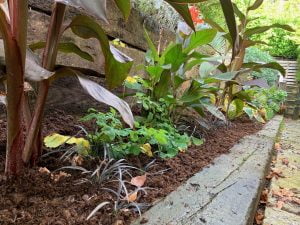
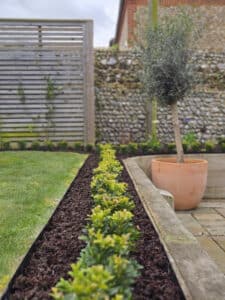
And the perfect, most effective way we can reduce water evaporation, is by using a high quality organic-rich mulch, spreading it over the garden borders, layering it on top of exposed soil and around the base of plants. And the best time to do this will be when the water content of the soil should be relatively high, either mid to late spring or during the autumn when the plants have started to die back.
What is a Mulch and what does it do?
Whilst many different materials could be used as a mulch to layer on top of garden soil, such as grit, wood chippings and grass cuttings, they won’t always be as multi-functional as a high quality as organic PlantGrow mulch, which can provide a number of highly important benefits to a garden.
Primarily, a thick layering of organic mulch on top of the soil and around the base of plants will significantly reduce water evaporation from the soil. The mulch will also suppress weed growth and provide an organic-rich habitat for numerous beneficial soil-dwelling creatures to thrive, such as carabid beetles and centipedes that predate on small slugs and snails. It will also host a vast community of detritovores, the creatures that feed amongst the mulch, gradually pulling it down and, over time, incorporating it into the soil where the nutrient-rich mulch will enrich the ground for the plants. A good quality mulch will also be populated with natural microbes, the fungi and bacteria that together form the soil’s microbiome, an essential component of healthy soil within which the microbiome further breaks down organic matter to release natural nutrients.
In fact, the soil’s microbiome directly controls the richness of the soil, which then subsequently enhances the plant’s ability to acquire water and nutrients through its roots. A benefit that will be highly relevant within a changing climate and the new pressures that extreme climatic events, heatwaves and droughts will cause the garden plants that gardeners and growers have been cultivating for food and pleasure for centuries.